

As youth suicide has surged 62 percent over the past decade and one in five high school students now seriously considers attempting suicide, the mental health crisis facing young Americans has outpaced the systems designed to help them. Traditional outpatient therapy, often requiring weeks-long waitlists, weekday appointments, and clinical settings that feel foreign to teens, fails to engage the majority of young people who need support, leaving them to struggle alone or turn to unregulated AI chatbots for guidance. Somethings has built a different model: on-demand access to Certified Peer Specialist mentors who are themselves young adults with lived mental health experience, trained and supervised by licensed clinicians to provide relatable support exactly when teens need it most. Through partnerships with Medicaid programs, state agencies, and school systems across the United States, the Brooklyn-based platform has supported over 11,000 teens, achieving a 65 percent reduction in depression and a 60 percent reduction in suicidal ideation among participants. The company’s technology enables mentors to connect with youth after school and into evening hours – the periods when isolation and emotional distress peak – while AI tools support safety screening and clinical escalation without ever interacting directly with users. With 1,100x user growth over the past year and demonstrated clinical outcomes that traditional models struggle to achieve, Somethings is proving that peer connection paired with professional oversight can meet young people where they are and keep them engaged in ongoing support.
AlleyWatch sat down with Somethings CEO and Founder Patrick Gilligan to learn more about the business, its future plans, recent funding round that brings the company’s total funding raised to $28.6M, and much, much more…
Who were your investors and how much did you raise?
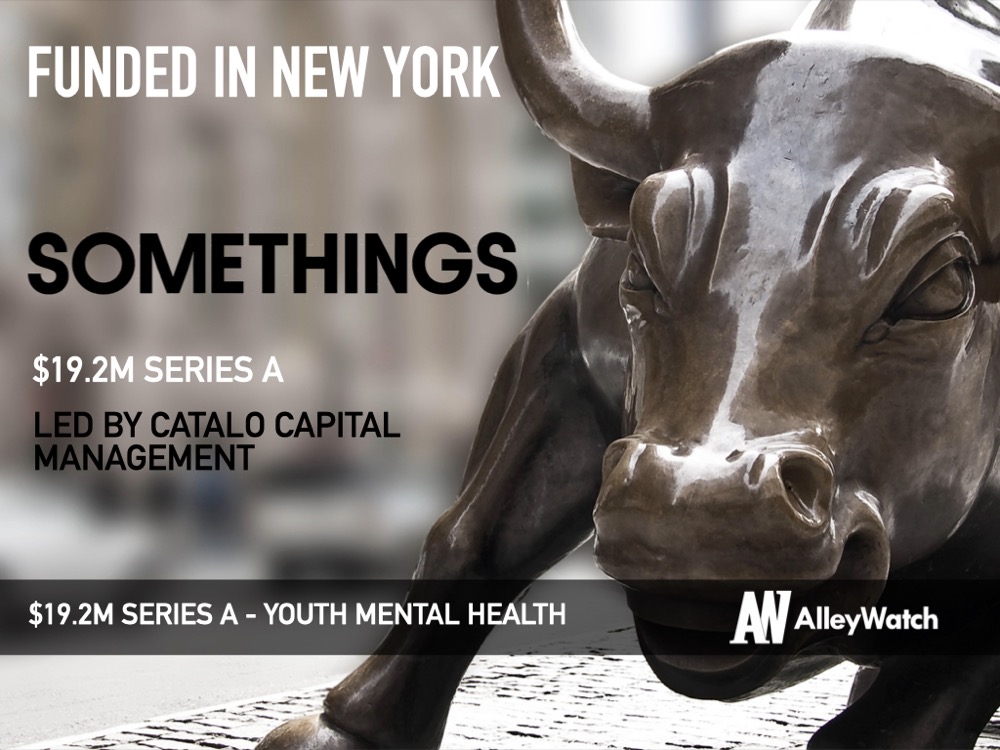
This was our Series A with $19.2M total funding led by Catalio Capital, with participation from existing investors General Catalyst and Tusk Ventures. We’re really excited to be able to raise such a strong Series A and see it as both a signal of support in the strength of our product and evolution of Somethings over the past four years, and the strength of the New York City market.
Tell us about the product or service that Somethings offers.
Somethings is a near-peer mentorship app that connects youth ages 13 to 26 with trained mentors ages 20 to 29 through real-time virtual support. Youth can connect with the same mentor after school hours for ongoing mental health support, all under the supervision of licensed clinicians.
We partner with states and Medicaid plans to close gaps in access to care, particularly for youth who might otherwise go unsupported. By training and certifying near-peer mentors, Somethings builds a new behavioral health workforce and delivers a model of care that youth trust and want to use.
What inspired the start of Somethings?
 Somethings is deeply personal to me. As a child, I struggled with an eating disorder and tried many traditional services, but none of them felt effective or truly supportive. The one thing that did help was connecting with a peer who understood my experience and met me where I was. That experience showed me the power of peer support.
Years later, while I was in college, a classmate died by suicide. That loss made it clear to me that I needed to do something more. I began by informally mentoring a few young people to see if peer support could help others the way it had helped me. From there, the idea grew and eventually became Somethings.
At its core, Somethings was built from my own experience and a belief that feeling understood by someone who has lived it can be life-changing.
How is Somethings different?
To address the youth mental health epidemic now in its eighth year, we have to do things differently. At Somethings our difference is not one feature but how the entire model is built. We take a hybrid product design and clinical approach centered on what teens tell us they actually need. From that foundation, three things set us apart.
First is our near-peer model. Many teens struggle to engage in traditional outpatient care because they do not feel understood by their provider. Even when care begins, youth often disengage for the same reason. While we believe traditional clinicians play an important role and employ licensed providers, many teens prefer speaking with someone closer to their lived experience. Youth may prefer to speak to near peers who grew up in the digital age speak the same language, and truly get it. By training and certifying these individuals as peer mentors, we have built a workforce youth want to connect with. In parallel we have built our clinical therapy services in a stepped care model for those who need therapy or prefer that service.
Second is near real-time access. Our mentors are available every weekday after school hours so teens can connect with the same mentor when support is needed. Issues rarely arise on the day of a scheduled therapy session. Today’s youth expect immediate support and without it often turn to AI instead of care. Our model allows for real time connection and higher touch support including for youth with elevated needs.
Third is how we reach and retain youth. Engagement has always been a challenge in youth mental health, and while no one has fully solved it, we have made meaningful progress. Through authentic social media engagement, we have built an audience of over 150,000 teens and drive thousands of sign-ups each month. In addition, we partner with over 200 schools and 250 clinical organizations. This ability to meet youth where they are has been critical to our success.
What market does Somethings target and how big is it?
We do not think about this market primarily in dollars but in lives impacted. Today, an estimated 25 million youth in the US struggle with mental health challenges and nearly 20 percent report suicidal ideation. This is the reality we are facing. Our goal is to positively impact one million youth through our peer support program. We believe reaching one million lives would allow us to meaningfully reduce the youth suicide rate back to 2008 levels, before rates sharply increased.
From a market perspective, youth mental health represents approximately $31B in annual spend and continues to grow each year as need rises. Beyond this, Somethings sits at the intersection of mental health, early identification, and prevention. Over time, we see our platform expanding to support broader healthcare needs for youth ages 13 to 26 representing a market opportunity of over $100B.
What’s your business model?
Somethings partners primarily with states and Medicaid managed care plans. We are paid either on a fee-for-service basis or through per-member arrangements, depending on partner needs. We work closely with each state or plan to design a payment structure that aligns with their goals and populations.
Our model delivers meaningful cost savings by reducing reliance on high-cost services such as emergency departments inpatient and residential treatment and avoidable outpatient utilization. By intervening earlier and keeping youth engaged in ongoing support we help plans and states improve outcomes while lowering total cost of care.
How are you preparing for a potential economic slowdown?
During economic downturns, household budgets tighten and access to mental health services often becomes more limited at the exact moment need increases. From the start, Something has been built to remove cost barriers for youth and families and all of our services are free to end users. We know being free to users if we were to face a slowdown will make the service easier to access.
As we plan for growth, we focus on partnering with states and plans that have stable funding streams and a long-term commitment to youth mental health. We also prioritize demonstrating clear clinical and economic value so partners see Somethings as an essential service rather than a discretionary one. This positions us to remain resilient even in more constrained economic environments.
What was the funding process like?
Raising a round always comes with highs and lows, especially early on when investor feedback can be mixed. In this round, we were fortunate to partner with Catalio Capital, who showed strong conviction in our model and mission from the very first meeting. Their early confidence helped create momentum throughout the process.
In addition, several existing investors including General Catalyst and Tusk Ventures chose to participate again. Continued support from prior investors is a powerful signal of confidence both for the team and for new partners evaluating the company.
While fundraising is never easy, this round came together smoothly, and we feel fortunate that strong alignment, returning investors, and clear belief in our approach helped everything fall into place.
What are the biggest challenges that you faced while raising capital?
The landscape for digital health investing is a bit slow right now and most investors are focused on AI investing. However, there were lots of people who understood the vision of what we are trying to build and who saw how the wave of AI enhances our position across the market.
What factors about your business led your investors to write the check?
We scaled greatly last year in user growth over 1100x and were able to demonstrate that teens who use the product see a material positive impact on their mental health.
What are the milestones you plan to achieve in the next six months?
We are focused on two key milestones over the next six months.
First is team growth. We are hiring for several critical roles across product and commercial functions. On the product side, these hires will help us continue building alongside teen voices, ensuring the platform reflects what youth actually want and need. On the commercial sid,e we are expanding capacity to enter new states, responding directly to consistent demand from teens asking for access where they live.
Second is expansion through rural health initiatives. We are seeing strong traction with state rural health transformation programs, where Somethings is uniquely well-suited. Our app is designed to work in low-access environments while also expanding the rural mental health workforce through near-peer mentors. We are actively partnering with multiple states and expect this to be a meaningful growth driver.
Overall, we will consider the next six months a success if we have grown our team, expanded into additional states and health plans, and supported thousands more teens with accessible mental health care.
What advice can you offer companies in New York that do not have a fresh injection of capital in the bank?
Keep testing and stay focused. Somethings has gone through many iterations, and our progress has come from running hundreds of small experiments every day. The strongest startups stay disciplined, test ideas continuously, and avoid getting distracted by short-term fundraising pressure.
Funding follows traction. For a long time, we struggled with user growth, but our head of growth stayed focused and tested new ideas every few weeks until something clicked. That breakthrough unlocked thousands of youth signups and became a key driver of our fundraising success. Staying focused and committed to testing is often what creates the momentum investors want to see.
Funding follows traction. For a long time, we struggled with user growth, but our head of growth stayed focused and tested new ideas every few weeks until something clicked. That breakthrough unlocked thousands of youth signups and became a key driver of our fundraising success. Staying focused and committed to testing is often what creates the momentum investors want to see.
Where do you see the company going now over the near term?
In the near term, our focus is simple and urgent: expanding access. Every day, youth download our app asking for help, and too often we are unable to serve them due to geographic or coverage limitations. That gap is deeply motivating for our team.
Our priority is to expand partnerships with states and health plans so that when a young person reaches out for support they can access care immediately. Over the short term, success means removing barriers, increasing coverage, and ensuring Somethings is available wherever youth are asking for it.
What’s your favorite winter destination in and around the city?
Honestly, I love cozying up in a great coffee shop around the City. Devocion has become a second home for me.