

American healthcare has long suffered from a structural mismatch: the system generates enormous demand for patient communication while the clinical workforce available to meet it continues to shrink. The World Health Organization projects a global shortage of 10 million health workers by 2030, and the gap is already visible in overloaded intake queues, missed follow-up calls, and patients left without support between appointments. Amigo AI addresses this capacity crisis by building and training AI agents that handle patient-facing clinical workflows, from intake and triage to 24/7 care navigation and post-visit support, giving healthcare organizations a way to extend their care teams without adding headcount. What distinguishes Amigo’s approach is its “digital residency” model: rather than deploying off-the-shelf AI, every agent trains across millions of simulated patient scenarios built around a specific practice’s population, reaching a 100% safety pass rate before ever interacting with a real patient. The platform has now logged more than 3 million autonomous patient encounters worldwide with zero safety incidents, and integrates natively with major EHR systems including Epic, Oracle Health, and Athenahealth across more than 100 languages.
AlleyWatch sat down with Amigo AI CEO and Cofounder Ali Khokhar to learn more about the business, its future plans, recent funding round, and much, much more…
Who were your investors and how much did you raise?
We announced our $11M Series A led by Madrona with participation from Optum Ventures, General Catalyst, and GSV Ventures. To date, we have raised $17M in total funding, including a seed round co-led by General Catalyst and GSV Ventures.
Tell us about the product or service that Amigo AI offers.
Amigo builds and trains AI agents that interact directly with patients across clinical use cases such as intake and triage, personalized care navigation, and 24/7 patient support. By handling high-value clinical workflows, Amigo agents enable healthcare organizations to improve patient outcomes and meaningfully expand the reach and impact of their existing care teams.
What inspired the start of Amigo AI?
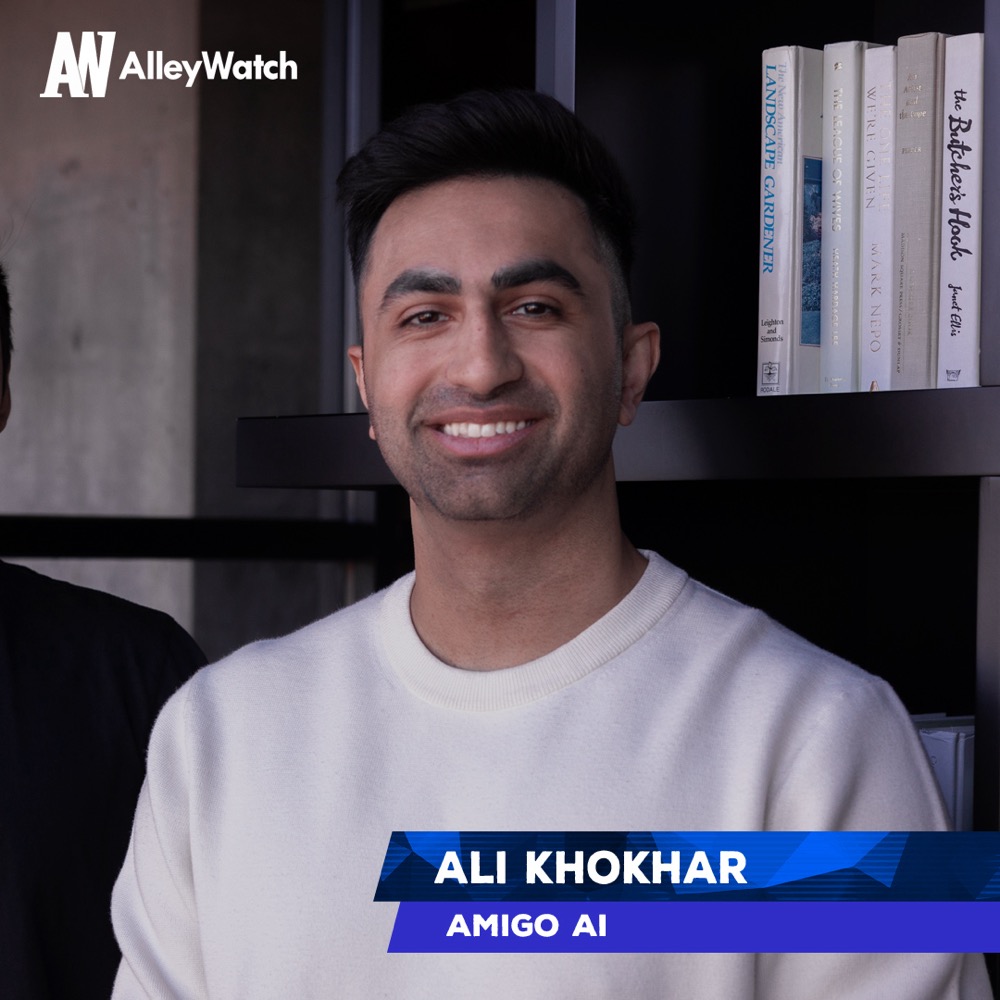 My mom was diagnosed with breast cancer when I was eight years old. Over the next six years, through two diagnoses, I watched her navigate a healthcare system that was never built to support her. What I remember most is how much work it was just to be sick. The same story told to every new specialist, the same exams repeated, referrals made and forgotten. And through all of the chemo, side-effects, and hard nights, the burden of coordinating my mom’s care always fell on our family. She passed away when I was fourteen. What I couldn’t shake was the feeling that so much of it didn’t have to be that hard. That became the inspiration to start Amigo.
How is Amigo AI different?
We built Amigo on the idea of “Waymo for healthcare AI” to bring Waymo-like thinking to healthcare. I think of self-driving cars as the only place where the cost of failure is fatal. Instead of rushing to deploy agents, we prioritize investing in more rigorous training of the AI agents in a proprietary “digital residency” to ensure they are fully equipped and experienced to handle various situations. Agents are trained on millions of simulated clinical scenarios before they interact with real patients.
What market does Amigo AI target and how big is it?
The market is huge. There’s a ton of opportunity in both traditional health care models (think solo clinics, providers, health systems) as well as digital health, virtual health, telemedicine companies. Not just to say the entire international market. There are a lot of countries that are pushing the boundaries for AI and what’s even possible.
What’s your business model?
We have two SKUs:
The monthly platform fee gives you a team of two: an agent engineer and a deployment strategist, as well as the training and simulation grounds for our AI agents. The actual usage fee that our agents cost as they draw down and they’re actually taking the burden off of the providers as they operate.
How are you preparing for a potential economic slowdown?
The economy will always have ebbs and flows. I think what matters is focusing on our singular mission of delivering care to patients in one way or another. Even if the economy slows down, it does not eliminate the demand or need for healthcare. If anything, being able to deliver care (increasing access) while making it more affordable will become even more important if the economy slows down.
What was the funding process like?
Fundraising is always a long journey, meeting tons of different investors. Our approach was just to get to a quick no or a quick yes as fast as possible. Investing time in those who really believe in John and I as founders and what we’re trying to achieve here at Amigo over the next decade. Our approach to clinical agents is unique and alignment there with our investors was an important piece of the puzzle that I personally cared a lot about. Luckily we were able to find that!
What are the biggest challenges that you faced while raising capital?
There’s a ton of buzz in AI, so it can be really hard to differentiate companies from other different companies. There are some that think of us as just off-the-shelf AI agents, and then there are those that we thought were really special and really understood the platform approach that we were taking. Building that infrastructure where there is a lot of differentiation to build those hyper-personalized clinical agents for all of our different customers
What factors about your business led your investors to write the check?
First and foremost, they bet on the team: myself and John Xing as co-founders (our complementary skillsets, our ‘why’ in healthcare), and the incredible team that we’ve been able to bring on board. Then there’s the growth. We have had explosive growth over the past 12 months and can’t hire fast enough. We’ve nearly doubled the team in the last 3 months and need to double again before the end of the year.
First and foremost, they bet on the team: myself and John Xing as co-founders (our complementary skillsets, our ‘why’ in healthcare), and the incredible team that we’ve been able to bring on board. Then there’s the growth. We have had explosive growth over the past 12 months and can’t hire fast enough. We’ve nearly doubled the team in the last 3 months and need to double again before the end of the year.
What are the milestones you plan to achieve in the next six months?
2026 is going to be the year where most organizations will start determining their patient-facing AI strategy. Our goal is to help them understand what is possible with today’s technology and how to deploy it safely. Our goal is to 10x our monthly patient encounters in the next 6 months, demonstrating our impact on patient lives.
What advice can you offer companies in New York that do not have a fresh injection of capital in the bank?
I’d say that all it takes is just one investor to really believe in you and what it is that you’re doing. We’ve all been through those tough times where we didn’t think that term sheet was gonna come through or we didn’t have that customer actually cross the line. It only gets better, and you can only look ahead for the next one.
Where do you see the company going now over the near term?
We’re hiring aggressively across the board. We’ve been onboarding customers quickly and one of the core areas of focus is going to be making sure that we are deploying agents as safely as possible to keep our standard of zero patient safety incidents.
What’s your favorite spring destination in and around the city?
I’ve been searching for the best halal cart in the city. Any recs, let me know!