

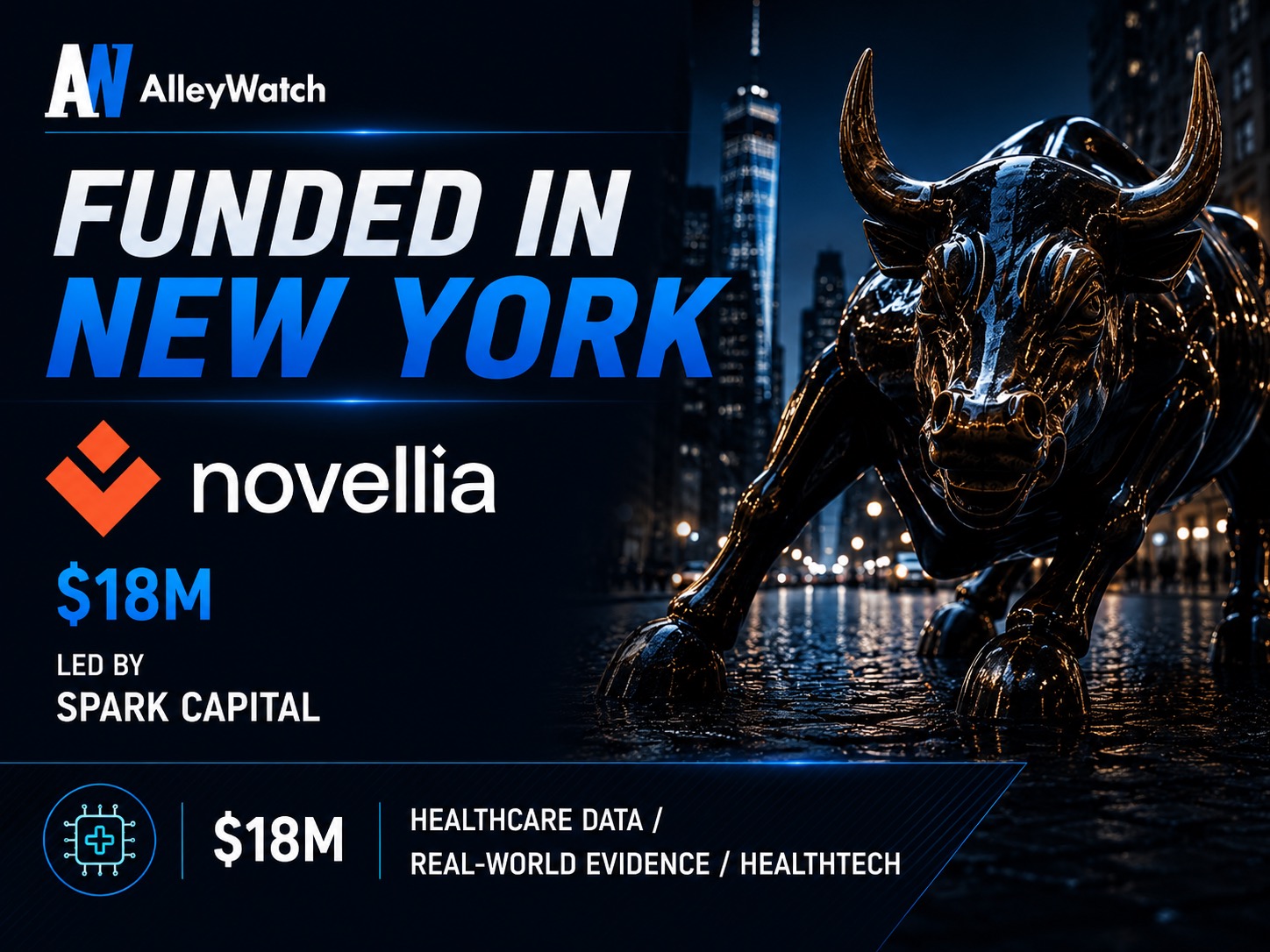
real world, but the infrastructure built to deliver that understanding has a fundamental flaw at its center: patients have no seat at the table. The industry spends more than $50B annually on real-world data ecosystems dominated by claims brokers and hospital record aggregators that stitch together incomplete, fragmented datasets while leaving out the people those datasets are supposed to represent. Meanwhile, patients with serious and complex conditions spend hours tracking down their own records across dozens of disconnected systems, carrying binders from specialist to specialist just to give each new provider a coherent picture of their history. Novellia attacks both problems simultaneously, giving patients a free tool to unify up to 20 years of health data from more than 50,000 healthcare systems in seconds, then, only with explicit consent, making that de-identified, anonymized data available to biopharma researchers as a longitudinal, continuously updated dataset that claims data and single-system EHR records simply cannot match. The platform’s proprietary NLP models extract signals from unstructured clinical text, including physician notes, lab narratives, and diagnostic reports, turning the richest and most overlooked layer of the medical record into research-ready intelligence. Already serving several of the top 10 pharmaceutical companies on seven-figure, multi-year contracts, and recognized by MedTech Breakthrough and Fierce Outsourcing for its impact on drug development, Novellia has now closed new funding to scale the platform and expand its patient community.
AlleyWatch sat down with Novellia Cofounder and CEO Shashi Shankar to learn more about the business, its future plans, and the recent $18M funding round that brings the company’s total funding to $28M.
Who were your investors and how much did you raise?
We raised an $18 million Series A led by Spark Capital with participation from Khosla Ventures, Acrew Capital, Bling Capital, and TMV, bringing our total funding to $28 million.
Tell us about the product or service that Novellia offers.
Novellia gives people living with serious and complex medical conditions a single place to find and unify their full medical history, labs, imaging, clinical records, across every provider they have ever seen. Most patients have no real idea where their critical health data lives or how to get their hands on it. We fix that, for free.
And only with patient consent, Novellia partners with the world’s leading biopharma companies to use de-identified, anonymized data for critical research. That is how we help people contribute to the discovery of new medicines, without asking anything of them beyond a yes.
What inspired the start of Novellia?
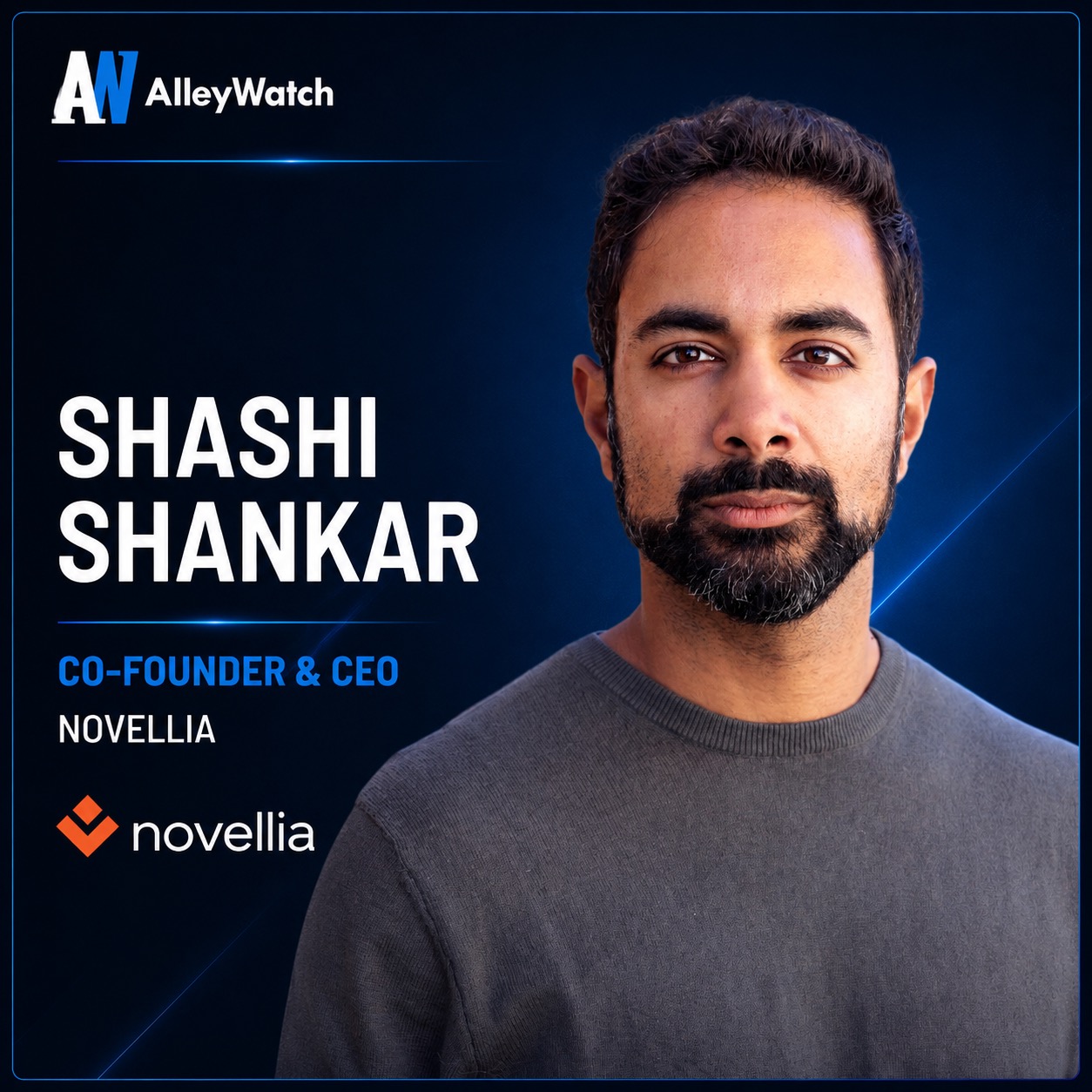 To be honest, I never actually wanted to start a company. But my grandfather was diagnosed with cancer, and I watched my mother become his primary caregiver. In the months he had left, my mom coordinated his care across labs, imaging centers, hospitals, and specialists. She carried binders of records from appointment to appointment, just trying to make sure every doctor had a complete picture of who he was and what his body had been through.
At the same time, I was working at Genentech, seeing firsthand how hard it was to access high-quality, longitudinal health data for research. The same fundamental problem from two completely different angles: critical health information was fragmented and nearly impossible to access at the moments it mattered most.
Novellia was built to solve that. One place for patients to access and manage their full health history, free of charge. A foundation for better research, better care, and ultimately better outcomes.
What market does Novellia target and how big is it?
Novellia provides data solutions for the pharmaceutical industry, which has a total addressable market of nearly $2 trillion.
What’s your business model?
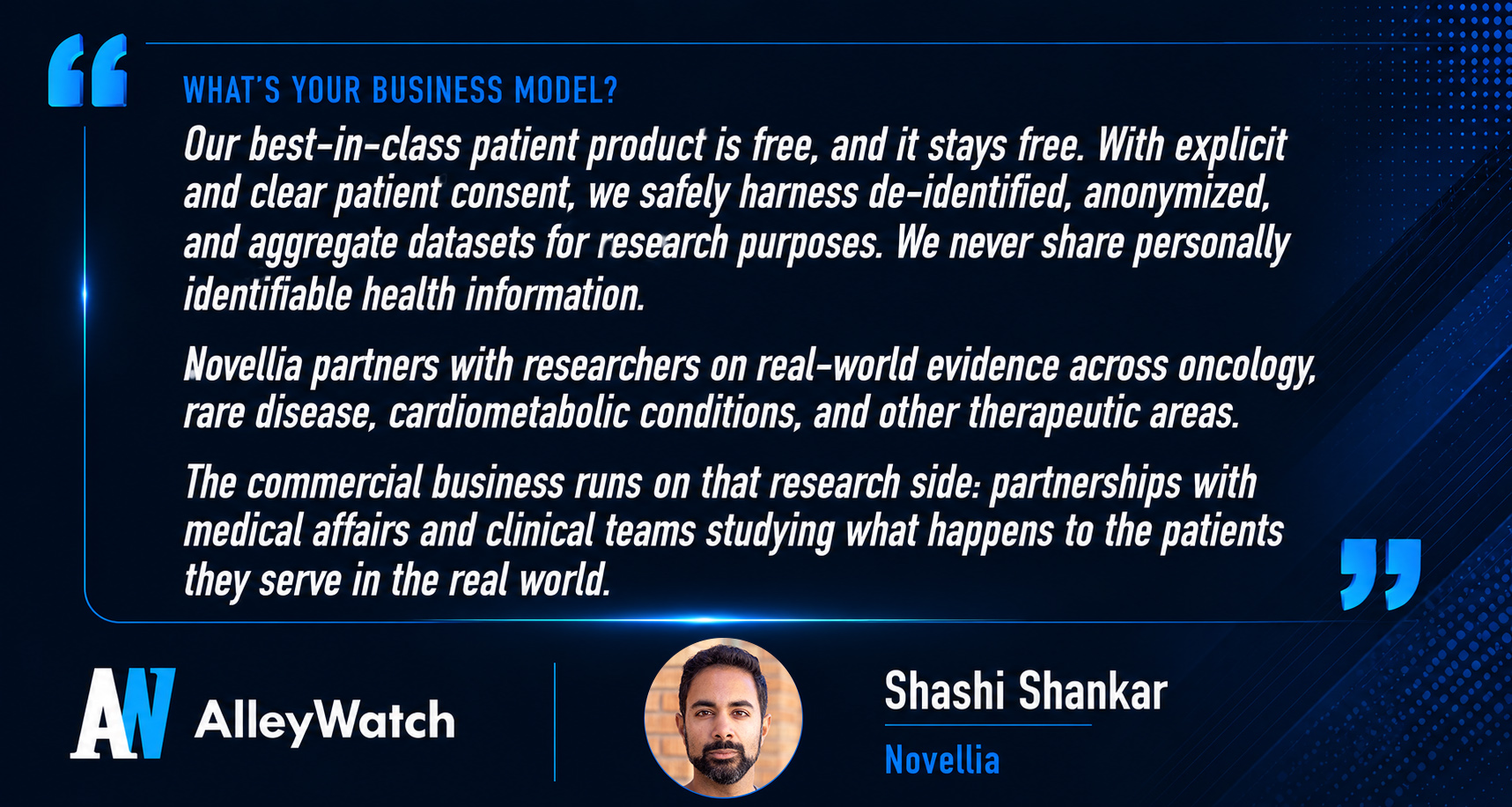
Our best-in-class patient product is free, and it stays free. With explicit and clear patient consent, we safely harness de-identified, anonymized, and aggregate datasets for research purposes. We never share personally identifiable health information. Novellia partners with researchers on real-world evidence across oncology, rare disease, cardiometabolic conditions, and other therapeutic areas. The commercial business runs on that research side: partnerships with medical affairs and clinical teams studying what happens to the patients they serve in the real world.
How are you preparing for a potential economic slowdown?
Life sciences, and particularly clinical development and medical affairs, has historically held up through economic cycles better than most industries. When budgets tighten and scrutiny on healthcare spending increases, demand for rigorous real-world evidence tends to increase with it. That dynamic works in our favor.
We also run a disciplined operation. Capital is being deployed deliberately: scaling the platform, deepening our life sciences customer relationships, and continuing to grow the patient community. Patient engagement has proven largely independent of macroeconomic conditions. People’s health needs do not follow an economic calendar.
What was the funding process like?
Humbling, in the best sense. You sit across from some of the sharpest investors in the world and quickly learn which parts of your thesis you can defend fluently and which parts need more work. The process forces a kind of clarity that nothing else produces.
The conversations that went deepest were with investors who had done real homework on the healthcare data architecture problem. Once someone understood the scale of fragmentation in health records, the conversation shifted from education to strategy.
Those were the partners we were looking for.
Finding Spark Capital, Khosla, Acrew, Bling, and TMV took time. These firms understood from the start that Novellia’s commercial model and its patient mission reinforce each other. That alignment shaped every conversation once term sheets were on the table.
What are the biggest challenges that you faced while raising capital?
The biggest challenge was the category itself. Real-world data has large, established players with deep enterprise entrenchment, and any investor familiar with the space would reasonably want to understand what makes your approach truly distinct.
The hardest thing to convey was the flywheel. Novellia’s only source of data is patients themselves. We built a product patients actually want to use and patients who choose to participate authorize health information that is longitudinal, cross-system, and continuously updated. We think it’s the highest quality healthcare data in the industry. When researchers gain access to that depth of evidence, they can study patient populations in ways that claims data and single-system EHR simply cannot support
What factors about your business led your investors to write the check?
Our investors recognized that Novellia is solving a longstanding challenge in pharmaceutical research, one of the largest and most economically stable industries on the planet: the industry’s reliance on data that is often fragmented, outdated, and disconnected from the patient experience. But what really stood out was that we approached the problem from a fundamentally different angle. Rather than building another data aggregation platform that operates behind the scenes, we started with the patient, creating a richer, more longitudinal dataset for research. It’s an incredibly difficult thing to do well, but when it starts to click into place, there really isn’t any other data source that can match its depth and quality.
Our investors recognized that Novellia is solving a longstanding challenge in pharmaceutical research, one of the largest and most economically stable industries on the planet: the industry’s reliance on data that is often fragmented, outdated, and disconnected from the patient experience. But what really stood out was that we approached the problem from a fundamentally different angle. Rather than building another data aggregation platform that operates behind the scenes, we started with the patient, creating a richer, more longitudinal dataset for research. It’s an incredibly difficult thing to do well, but when it starts to click into place, there really isn’t any other data source that can match its depth and quality.
What are the milestones you plan to achieve in the next six months?
Over the next six months, we will use the funding to further scale Novellia’s technology platform and accelerate our go-to-market efforts. Today, our customers include several of the world’s largest pharmaceutical companies. This funding will allow us to deepen those relationships, reach new customers, and continue growing the platform to better serve both patients and the life sciences industry.
The patient side and the commercial side move together. That is the plan.
What advice can you offer companies in New York that do not have a fresh injection of capital in the bank?
If you’re building a venture business, go for the grand slam. Stop thinking about what it takes to get on first or second base. You should be thinking about doing whatever it takes to hit a grand slam and don’t, for a moment, envision any outcome other than you doing this. Stop worrying about striking out. Go for gold. Take real risks and do whatever it takes. You learn fast when the stakes are real. Moving forward before everything is figured out is part of what gets you somewhere worth going.
Balance honesty and maintaining a contagious, stratospheric vision/ambition with your team. The founders I’ve seen navigate hard stretches best are the ones who communicate clearly and trust their people with the reality of the situation. Honesty builds the kind of trust that holds a team together when things get difficult. On the other side, you need to get galactic when you’re talking about the mission – your team should feel in their bones that this work is going to change the world! Your enthusiasm and raw conviction in your vision needs to be shared and felt by every single member of your team.
And use the New York ecosystem. It is incredibly collaborative and incredibly honest. New Yorkers are frank and low/no-BS by nature. Warm introductions, peer founder communities, the concentration of healthcare and life sciences companies here. Those relationships matter when you’re extending runway.
Where do you see the company going now over the near term?
The thing I keep coming back to is what it means to be the connective tissue. Right now, a patient’s health data exists in dozens of disconnected places: their cardiologist doesn’t know what their oncologist did, their insurer is working from claims, the biopharma company building life-changing medicines for them is inferring from incomplete population averages. Everyone is operating on a partial picture.
Where Novellia goes is toward becoming the canonical source of truth for a patient’s health, and by extension, the infrastructure that connects patients to every single stakeholder in their ecosystem: their care team, their researchers, their insurers, the scientists developing the next generation of treatments. Not a middleman. The layer that makes all of those relationships work better.
Near term, that means scaling the platform, deepening our life sciences partnerships, and continuing to grow a patient community that trusts us as partners in their healthcare journeys.
But the north star is bigger: a world where a patient’s health record isn’t something they have to chase down and carry in a binder but rather something that flows, with their consent, to the people and institutions that need it to keep them healthy and push medicine forward.
What’s your favorite spring destination in and around the city?
A few spots! My wife and I love a good boogie, so any rooftop or garden in Brooklyn on a beautiful spring day with great tunes is a must. I also love running around Brooklyn with a good podcast; Prospect Park and the BK waterfront are favorite spots. And because I’m embarrassingly mainstream, Bathhouse, which now happens to have a location walking distance from my flat.