


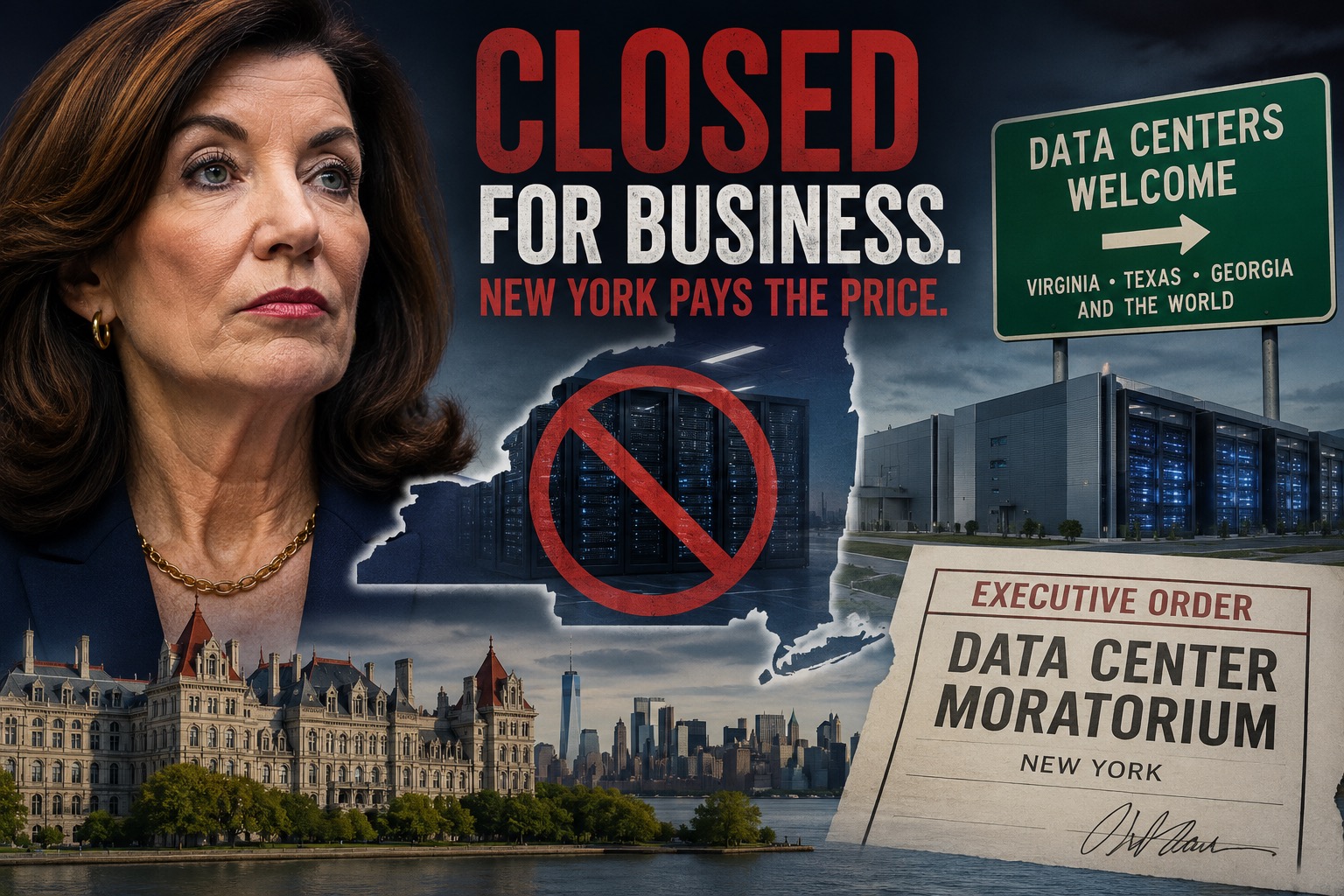
Kathy Hochul’s data center moratorium is cynical politics dressed up as environmental stewardship — and New York will pay the price.
Governor Kathy Hochul has made history for all the wrong reasons: a one-year moratorium on large-scale data center construction, making New York the first state in the country to effectively shut the door on one of the fastest-growing sectors of the global economy. She calls it bold leadership. It’s neither.
Hochul justifies the move by claiming that data centers “threaten to hike up utility bills, deplete natural resources, and create uncertainty for New Yorkers.” It’s a politically convenient narrative and an economically incoherent one.
Start with the supposed energy crisis. As of May, nearly 12 gigawatts of data center demand sat in the NYISO interconnection queue, with more than 8 gigawatts entering in 2025 alone. That demand didn’t appear overnight – it reflects a fundamental reality: AI infrastructure is the defining industrial buildout of our time. Every gigawatt New York refuses to host doesn’t disappear. It gets built in Virginia, Texas, Georgia, or overseas. New York forfeits the jobs, tax revenue, and economic spillover while others capture the upside.
Industry leaders warning that this policy cedes ground in the AI race aren’t exaggerating. The math is simple: capital flows where it’s welcomed. And once billion-dollar infrastructure investments land elsewhere, they don’t circle back.
The political timing is hard to ignore. As affordability concerns mount, Hochul is looking to deflect blame for high energy costs. Yet earlier this year, she softened the state’s greenhouse gas targets precisely because energy had become too expensive. Now, instead of expanding supply or accelerating grid modernization, she’s blocking a category of investment that could help fund and justify those upgrades.
Just as troubling is how this was done. The Legislature passed its own moratorium bill, but Hochul dismissed it as too complex – then sidestepped the process entirely with an executive order. That’s not governing; that’s an end-run around the process when the process became inconvenient.
The administration points to a higher threshold – 50 megawatts instead of the Legislature’s 20 as evidence of moderation. It changes nothing. The signal to the market is the same: New York is closed for business on next-generation infrastructure.
And the inconsistency doesn’t stop there. Days before issuing the moratorium, Hochul stood in Central New York celebrating Micron’s $100 billion semiconductor project – a facility producing the very components that power data centers. The state will build the chips but ban the buildings that run them.
New York was never the dominant destination for hyperscale data centers. This policy ensures it never will be. Companies making long-term capital decisions don’t wait for “frameworks” and “studies.” They move on.
That’s exactly why similar moratorium efforts have stalled elsewhere. Even Maine’s Democratic governor vetoed a comparable measure, recognizing that blocking investment, especially in economically fragile regions, comes at a real cost. Hochul has now taken New York where even more cautious states declined to go.
Over the next year, the state will study community benefits agreements, labor standards, and environmental impacts. Those are valid considerations but they are routinely addressed alongside development, not in place of it. Treating regulation and growth as mutually exclusive is a choice, not a necessity.
New York had a credible path to becoming the AI infrastructure hub of the Northeast, anchored by proximity to financial markets, deep talent pools, and global connectivity. That opportunity is now in jeopardy.
This isn’t leadership. It’s an election-year calculation dressed up as conscience and New York’s economy will absorb the cost long after the votes are counted.