


The $250B wine and liquor retail industry operates on systems built for generic retail, forcing independent stores to navigate complex vintage management, state-specific tax laws, break-pack pricing, and age verification with software never designed for these unique challenges. Each week, store owners spend hours manually entering data from distributor invoices, cobbling together disconnected systems for point-of-sale, e-commerce, and delivery integrations while losing sales to poor inventory sync across channels. Santé addresses these operational inefficiencies with a purpose-built AI operating system that unifies inventory receiving, POS, e-commerce, delivery marketplaces, marketing, and payment processing into a single platform designed specifically for beverage alcohol retailers. The platform’s AI-powered invoice scanning eliminates manual data entry, while automated product cataloging and customer segmentation features have driven 400% growth and enabled hundreds of stores to process $500M in annual card volume. With its recent acquisition of platform capabilities and strategic integrations with major delivery marketplaces like DoorDash, Uber Eats, and Instacart, Santé positions independent retailers to compete effectively against large grocery chains while managing the regulatory complexity that makes this industry uniquely challenging.
AlleyWatch sat down with Santé CEO and Founder Darren Fike to learn more about the business, its future plans, recent funding round, and much, much more…
Who were your investors and how much did you raise? Was it seed, Series A, B, etc?
We raised $7.6M in seed funding led by Bonfire Ventures, with participation from Operator Collective, Y Combinator, and Veridical Ventures.
Tell us about the product or service that Santé offers.
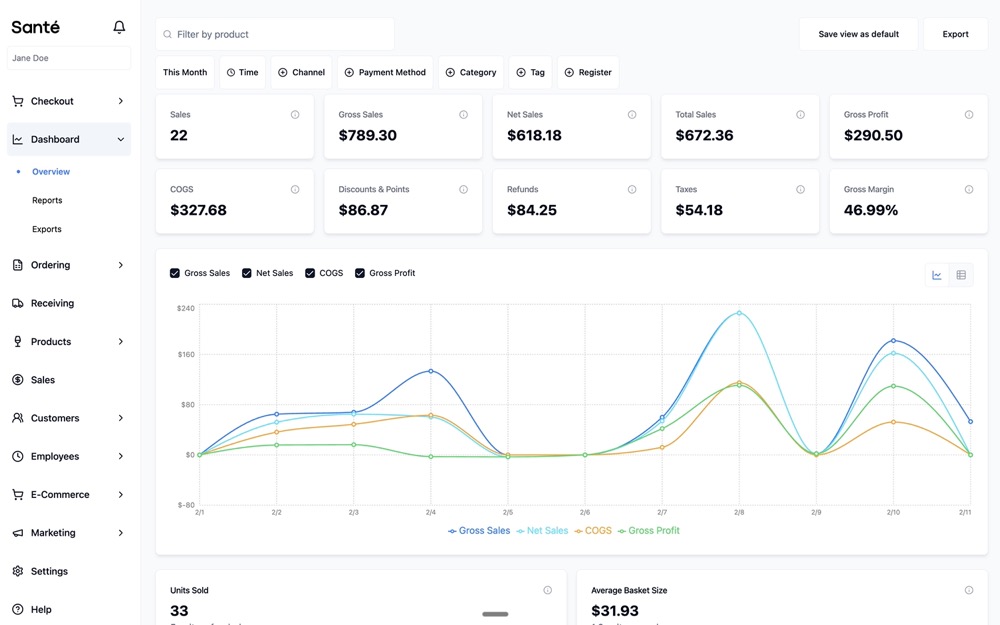
Santé is a purpose-built AI fintech operating system for wine and liquor retailers. It combines inventory + receiving, POS, e-commerce, delivery marketplace integrations, marketing, reporting, and payments/fintech tooling in one platform. It also includes AI features that automate high-friction tasks like invoice intake, product catalog creation, customer segmentation, and merchandising workflows.
What inspired the start of Santé?
 Wine and liquor retailers handle complex inventories and compliance requirements, but most software was built for generic retail. Santé started to solve the operational reality store owners live with every day: messy distributor invoices, complex inventory rules, and heavy regulation, plus the pressure to sell across in-store, online, and delivery channels without adding headcount.
How is Santé different?
Santé is different in three ways:
- It’s built specifically for beverage alcohol, including vintage management, break-pack logic, ID verification, bottle/keg tracking, and distributor management.
- It’s unified, inventory, e-commerce, delivery, marketing, and reporting all run off the same system of record.
- Its AI is embedded into core workflows, automating tasks that usually require manual entry and constant cleanup.
What market does Santé target and how big is it?
Santé targets the $250B wine and liquor market. This is made up of hundreds of thousands of small businesses that don’t have the capacity to develop or install complex systems. Beyond that, we’re looking at convenience stores and grocery stores, with markets that reach in the trillions of dollars.
What’s your business model?
Santé is a SaaS and fintech platform, monetizing platform, and add-on subscriptions with meaningful revenues coming from payment processing and other financial services products.
How are you preparing for a potential economic slowdown?
We help our customers with what matters most: growing their bottom line. We do this by increasing sales with eCommerce, marketing and loyalty built directly into the platform so that our customers are never missing a sale. We’re also reducing labor costs by simplifying manual work with AI. These liquor stores tend to be recession-proof industries with smaller transactions than electronics, appliances, or others.
What was the funding process like?
We are blessed with incredible investors including Bonfire Ventures, Operator Collective, Y Combinator, and Veridical Ventures. Initially, our focus was to convince investors the messy and fragmented industry could see a singular tech company consolidate it. Later on, much of our discussions were metric-driven after showing our 400% growth and $500M in GMV/card volume processed. The process emphasized proof that Santé is becoming a system of record, not just another tool.
What are the biggest challenges that you faced while raising capital?
Two common ones:
- Helping investors understand why this category is uniquely complex, and why that complexity becomes a moat for a purpose-built platform.
- Communicating how we’re full-stack (inventory + commerce + fintech + AI) while staying crisp about the wedge and near-term path to scale.
What factors about your business led your investors to write the check?
- Clear product-market pull in a vertical that’s been underserved.
- Strong traction (400% growth, hundreds of stores, $500M processed volume).
- High switching value: once a retailer runs inventory, receiving, ecommerce, and marketing in one place, the platform becomes sticky.
- A roadmap that expands wallet share over time across POS, marketing, e-commerce, delivery, and fintech.
What are the milestones you plan to achieve in the next six months?
- Expand distribution by scaling the sales motion and onboarding capacity.
- Launch into new verticals like convenience stores and grocery stores that struggle with similar complexities
- Go deeper on AI automation; merchandising, reordering and employee scheduling
- Improve measurable outcomes for customers (time saved, increased sales, fewer stockouts, better margins).
What advice can you offer companies in New York that do not have a fresh injection of capital in the bank?
Get ruthless about ROI. Ship what drives revenue, retention, or cost savings fast. Tighten collections, shorten payback periods, and don’t build “nice-to-have” product. If you’re selling to SMBs, make your value simple: increasing sales and saving time that can be better invested in growing the business.
Where do you see the company going now over the near term?
Near term, the focus is scaling what’s working in wine and liquor retail while expanding into adjacent categories that share similar complexity. The goal is to become the default operating system for these retailers, powering inventory, commerce, marketing, delivery, and payments, payroll and bookkeeping from one platform.
What’s your favorite winter destination in and around the city?
West Side Highway running path for a good jog and fresh air.