


US healthcare insurers spend $950B annually on administrative costs while hundreds of thousands of nurses and physicians process paperwork instead of practicing medicine, creating a dual crisis of burnout and inefficiency. This administrative burden extends across every payer function, from prior authorization delays that keep cancer patients waiting weeks for care approval to manual payment integrity reviews that drain clinical resources. Anterior addresses this systemic problem with an AI platform that automates clinical and administrative workflows across health plans, deploying directly into existing systems with embedded forward-deployed clinicians who ensure accuracy and adoption. The company’s approach delivers 99.24% clinical accuracy in live production environments, reducing review cycles by 75% while achieving 182-second average approval times for procedures that previously took weeks. Since 2024, Anterior has scaled to support organizations covering 50M lives through strategic integrations with enterprise platforms like HealthEdge and deployments across major insurers including Geisinger Health Plan, where cancer care approvals now happen while patients remain in consultation rooms.
AlleyWatch sat down with Anterior CEO and Founder Dr. Abdel Mahmoud to learn more about the business, his journey from physician to Google product leader to healthcare AI entrepreneur, recent funding round, and much, much more…
Who were your investors and how much did you raise?
Anterior just raised a $40M funding round, bringing their total capital raised to $64M. The oversubscribed round included continued participation from NEA and Sequoia Capital, alongside new investors FPV and Kinnevik.
Tell us about the product or service that Anterior offers.
Anterior powers clinical and administrative automation across all healthcare specialties and workflows, making the operational layer of healthcare effectively invisible.
Today, health insurers employ hundreds of thousands of clinicians to process paperwork instead of practicing at the top of their license. This isn’t limited to any single workflow. Prior authorization, care management, risk adjustment, payment integrity — the same story of manual review, delay, and burnout repeats across nearly every operational function in a health plan.
Anterior addresses all of it. The platform gives health insurers everything they need to run AI safely at enterprise scale (e.g., security, compliance, integrations, auditability) plus pre-built clinical actions that can be combined to solve any workflow.
Prior authorization is one powerful example. In our deployment with Geisinger Health Plan, cancer care approvals that previously took weeks now happen in roughly 155 seconds, with 99.24% clinical accuracy (validated by KLAS Research).
That means that a cancer patient can get their care approved while still sitting in the consultation room. But that same technology extends across the full spectrum of clinical operations, and customers routinely expand from one workflow to many.
Anterior uses AI to remove the administrative friction that makes healthcare worse for everyone. The result: faster decisions for patients, lower costs for payers, and less burnout for providers.
What inspired the start of Anterior?
 I am a physician and former Google Product Manager who experienced firsthand how administrative burden drains time and energy away from patient care. Early in my medical career, I saw how much of modern healthcare was consumed by paperwork, manual reviews, and fragmented workflows. Rather than accept it as inevitable, I left clinical practice to build a solution.
I recognized that large language models represented a genuine step change in what was possible. Not marginal efficiency gains, but a chance to fundamentally redesign the operational layer of healthcare.
That vision became Anterior, which powers administrative automation across all healthcare specialties and workflows, making the operational layer of care effectively invisible. By removing repetitive administrative work, healthcare organizations can move beyond siloed departments handling utilization management, care management, and quality in isolation. In their place, a continuous intelligence layer can operate across the entire care continuum.
When that shift happens, clinicians practice at the top of their license at scale, costs decline, and patient outcomes improve. That was the inflection point Abdel saw. It felt like the right moment in history to reimagine how healthcare could truly operate.
How is Anterior different?
Anterior is different in three ways.
- One: they’re healthcare-native, with over 40% of the team being nurses and physicians. These aren’t siloed ‘SMEs’ either; clinicians are integrated across all departments and part of the company’s DNA (e.g., in product, engineering, deployments, go-to-market, and more). This is important because clinical reasoning in healthcare is hard, and you can’t just solve it with generic The same company automating your HR tickets is not going to get your clinical decisions to 99%+ accuracy.
- Two: Anterior is a platform, not a point Health plans don’t need forty different AI vendors for forty different workflows. Anterior’s technology is generalizable across prior authorization, care management, payment integrity, risk adjustment, and more. Consider them one clinical AI partner across the organization.
- Three: they have forward-deployed engineers (a concept borrowed from Palantir) and have pioneered the idea of forward-deployed clinicians who embed with the customer to ensure AI works in the real world. That’s why Anterior has the best accuracy on the market (99.24% clinical accuracy in live production as validated by KLAS Research).
What market does Anterior target and how big is it?
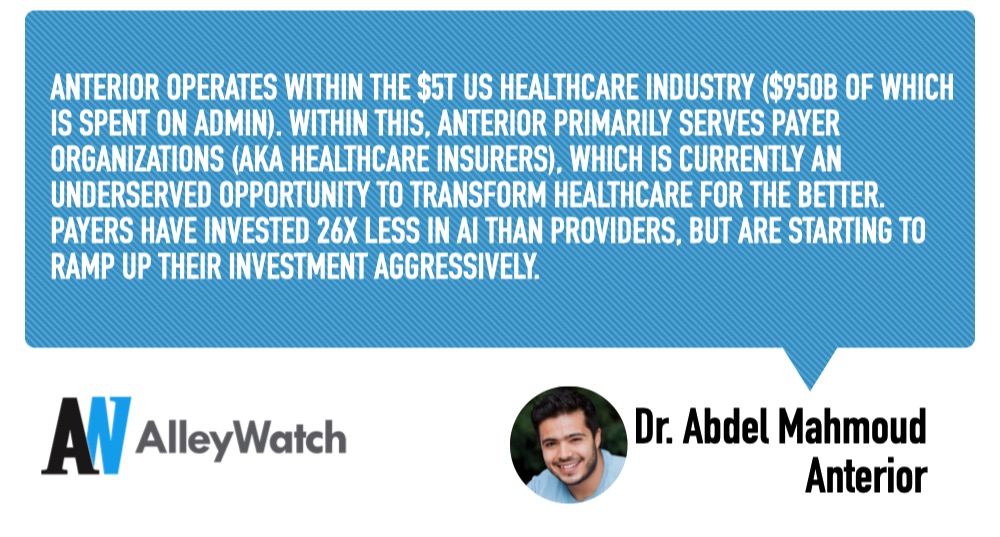
Anterior operates within the $5T US healthcare industry ($950B of which is spent on admin). Within this, Anterior primarily serves payer organizations (aka healthcare insurers), which is currently an underserved opportunity to transform healthcare for the better. Payers have invested 26x less in AI than providers, but are starting to ramp up their investment aggressively.
Our customers can be broken down into two categories:
- First are administrative organizations that do admin work on behalf of health plans. These customers typically want a full off-the-shelf solution they can deploy quickly, which Anterior provides.
- Second are national and regional health These plans are worth billions of dollars each and serve millions of people across the United States. While regional plans look for a proven, ready-to-deploy solution, nationwide plans tend to want an AI partner to plug in and accelerate their existing roadmap.
Anterior’s technology is currently live across tens of health plans, including some of the largest insurers in the United States. Its platform supports high-impact functions such as utilization management, care management, payment integrity, and pharmacy operations. Longstanding public partners like MedWatch and Geisinger Health Plan demonstrate the model in action. After early success, Geisinger expanded its deployment across multiple additional specialty areas, reflecting both measurable results and growing institutional trust.
What’s your business model?
Anterior’s technology has created an opportunity for health plans to do two things: 1) streamline their operations and 2) focus on the areas that really create value for everyone (patients, providers, and the plan itself). Anterior takes a share in the value we create, through various models depending on the use case and the needs of the specific customer. Pricing is something each health plan negotiates differently, and it wouldn’t be fair to share specifics.
Anterior is very deliberate about value-based pricing, and they don’t charge unless there’s a measurable impact. Anterior wants their incentives aligned with customers, which means they need to actually deliver ROI to get paid.
That keeps things honest, and it keeps customers confident they’re not paying for a science experiment.
How are you preparing for a potential economic slowdown?
Despite a potential economic slowdown, healthcare will always be running. It is an essential industry that, despite its hiccups, will continue to persevere even through financial crises, global shutdowns, and any other problem thrown into the mix. However, the industry will always need to be improving upon itself and keeping up with the global state of things.
Not to mention, this kind of technology is vital when it comes to shifting trends and needs within healthcare. One example is the aging population – 4M Americans turn 65 this year. An aging population has implications on cost of care, staffing needs, and clinical resources. Innovative high-cost medications like GLP-1s also drive up costs, and healthcare spend will continue to rise if nothing is done to mitigate these things.
That’s where Anterior’s technology comes in and remains relevant. A platform like Anterior, which has highly generalizable technology that helps across the full range of clinical and operational workflows, is optimal for helping health plans and clinicians continue to flourish even amidst economic slowdown or evolving industry trends . Things may get scary in the world, but we have the power to maintain quality care even in the worst of times.
What was the funding process like?
We were fortunate: our investors pre-empted the round, so the process wasn’t drawn out. We went through typical diligence, but there was no prolonged fundraise. Our investors had seen our traction firsthand and moved quickly to lead the next round.
What are the milestones you plan to achieve in the next six months?
Running on the momentum of this recent capital, Anterior is on a quest to make healthcare better for everyone by becoming the default clinical AI partner for health plans. This includes three main goals for the next 6 months:
- First, expanding their footprint with the largest insurers in the country. Anterior is working with many of the top 10 and deepening existing deployments in other customers, too. They are partnering with organizations covering over 50 million lives today, and their goal over the next year is to double that to 100 million.
- Second, building out ecosystem integrations. Anterior already has some partnership announcements in the pipeline on that front (see their recent partnership with HealthEdge).
- And third, further scaling their forward-deployed model (the engineers and clinicians embedded with customers), which is core to how Anterior delivers results in production.
Where do you see the company going now over the near term?
Anterior’s goal is to serve as the broad clinical AI partner for health plans. Because Anterior’s technology is highly generalizable, they help across the full range of clinical and operational workflows that today operate in silos. Scaling AI for the healthcare enterprise is serious work. These organizations are large, complex, and often underestimated. From day one, Anterior has taken security, accuracy, and scalability very seriously. As they continue to grow, they plan to keep investing in this foundation and become the true, all-in-one AI partner for health plans and clinicians.