



Commercial real estate lenders face nearly $1T in loan maturities over the next two years, and most of their credit analysis still happens by hand. Each loan gets underwritten at origination, every quarter, at extension, and at refinancing, and every pass starts with rent rolls, leases, and operating statements that never share a format, so hiring more analysts cannot keep pace. CarbonAI builds AI agents that run that analytical work from underwriting and due diligence through investment memos and post-close surveillance. The agents structure the messy documents, populate each lender’s own models and memos, validate every figure against its source, and route judgment calls to the lending team. Early customers report cutting time on core underwriting tasks by as much as 90%, and the company reached seven figures of ARR within six months. Because the agents log every action, lenders can defend each number in front of credit committees and regulators.
AlleyWatch sat down with CarbonAI Cofounders Jeff Saul (CEO) and Josh Kaufman (COO) to learn more about the business, its future plans, recent funding round, and much, much more…
Who were your investors and how much did you raise?
We’ve raised $12M in total funding, led by Cowboy Ventures, with participation from Timber Grove Ventures, Bling Capital, and Max Ventures.
Tell us about the product or service that CarbonAI offers.
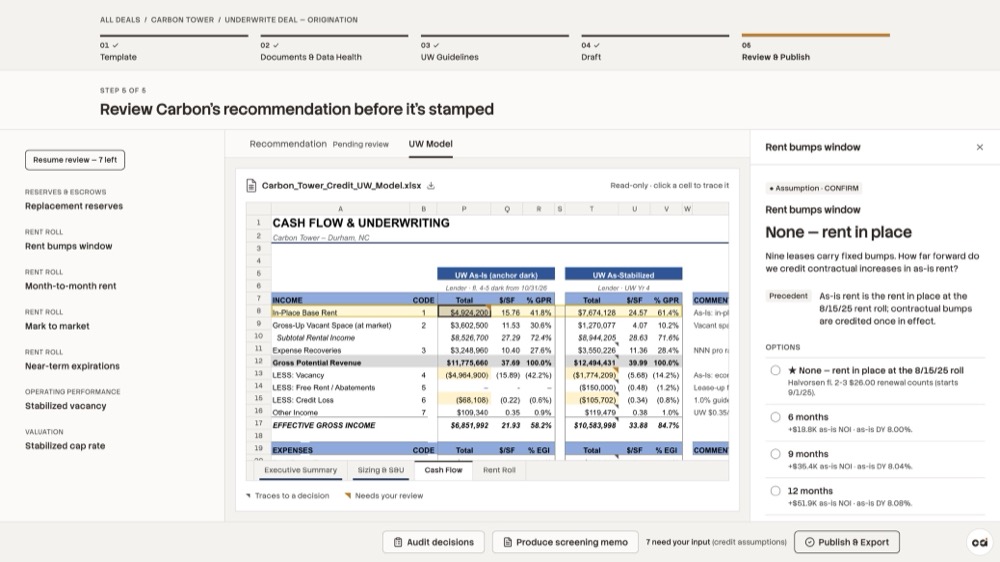
CarbonAI builds AI agents for commercial real estate lending teams. Our agents run the analytical work across the full life of a loan, including underwriting, due diligence, investment memos, and post-close surveillance. They start by analyzing and structuring the messy, fragmented documents that underpin the loan, such as rent rolls, leases, financial statements, and loan documents. Then they run the workflow itself in the lenders own unique models and memos: building the underwriting, drafting the memo, and flagging risk. Every figure is validated and traced back to its source document, and the agents route the decisions that need human judgment to the lending team. After a loan closes, the same agents monitor the health of the loan as new information comes in and present it in the lenders preferred formats with full auditability. The result is that you can make and manage more loans with the same team and materially mitigate risk with higher fidelity information and upleveling where your team spends their time.
What inspired the start of CarbonAI?
 We both started our careers in the trenches of CRE finance. Josh was in underwriting and asset management at Morgan Stanley, where he spent hours of his day wrangling documents and triaging data just to report on the health of loans each quarter. Jeff spent years in lending and investment roles, most recently at Starwood Capital, often working on spreadsheets with no system to help. We both lived the pain, and the degraded decisions, that slow, messy legacy workflows bred.
We founded Nativ, a CRE lending deal management platform, and grew it to more than 30 lenders and over $300B of AUM on the platform before selling it to Built. Even then, technology could only automate a small slice of the work. In 2024, as large language models and then agents became powerful enough to structure unstructured data and execute real workflows, we saw that the analyst work we used to do by hand could finally be automated which birthed Carbon. It is a natural evolution of our mission to make the capital underpinning our built world more efficient and effective. We understand the problem space deeply both as practitioners and technologists and believe that AI has the power to transform this industry if properly wielded.
How is CarbonAI different?
Most AI in our space is a chat tool you prompt deal by deal. It makes mistakes you can’t trace, and it doesn’t scale. Lenders don’t need that. They need agents that already know the domain and do the work reliably across the spectrum of deals that show up in the wild.
We know because we did this work ourselves as lenders. So Carbon is built the way a seasoned underwriter thinks and operates. It takes the messy, non-conforming rent rolls, operating statements, leases and loan docs our industry runs on, extracts and validates them, and flags anything that doesn’t tie out. It learns and uses each firm’s own lending parameters, models and reports, and gets sharper with every deal. And because we’ve sat through credit committees and regulatory audits, every data point traces back to its source and every agent action is logged so you always can audit right back to the root source.
The result is certainty of execution at scale. Underwriters spend less time triaging documents and more time on the deal. Carbon is already doing this on real deals for our customers.
What market does CarbonAI target and how big is it?
We serve commercial real estate lenders, from debt funds and mortgage REITs to agency lenders, banks and publicly traded institutions. CRE is one of the largest asset classes in the world, roughly $20 trillion in the U.S. alone, and nearly all of it is still underwritten and monitored by hand. With nearly $1 trillion of loan maturities coming due over the next two years and originations climbing, lenders need to do more with the teams they have but cannot sacrifice quality of the credit analysis.
What’s your business model?
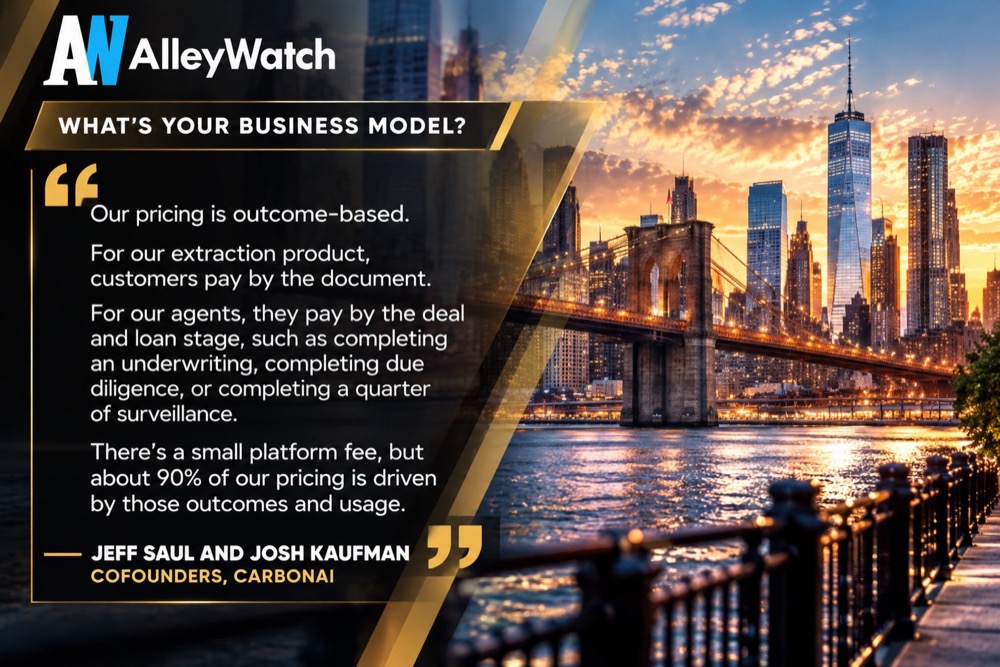
Our pricing is outcome-based. For our extraction product, customers pay by the document. For our agents, they pay by the deal and loan stage, such as completing an underwriting, completing due diligence, or completing a quarter of surveillance. There’s a small platform fee, but about 90% of our pricing is driven by those outcomes and usage.
How are you preparing for a potential economic slowdown?
Distress actually increases the need for what we do. Rising rates have lenders asking which loans in their books are solid and which are quietly deteriorating, and a slowdown only sharpens that question. On our side, we’ve been AI-native since day one, so we run lean and invest carefully. This funding goes mostly to product and hiring.
What was the funding process like?
Having raised and built before, we went in knowing exactly what we wanted: partners who understand vertical AI and will stay with us for the long haul, not just the biggest check. Our traction let us run a focused process and pick our partners. We’re thrilled Cowboy led, and it meant a lot that existing investors like Bling Capital, Timber Grove and Max Ventures doubled down. Then we got right back to work!
What are the biggest challenges that you faced while raising capital?
The biggest challenge is that fundraising is a full-time job, especially when you’re being picky about strategic fit, and it can easily pull you away from the business. We’d been through it before with Nativ, so we knew to protect against that. We’ve built a team that truly owns the problem and the outcomes. Our job is to make sure everyone is aligned on the “what” and the “why”, then give them the trust and room to own the ‘how.’ That’s what let us raise without missing a beat on product and customers.
What factors about your business led your investors to write the check?
Three core things:
- First, the team. Jeff and I spent years underwriting, closing and managing CRE loans at Starwood, Morgan Stanley and others. Then we built Nativ, which more than 30 lenders adopted before Built acquired it. Our investors were backing people who’ve done the job and already built software lenders trust.
- Second, traction. While still in stealth, we crossed seven figures of ARR in six months, working with some of the leading players in CRE finance. Early customers have cut time on core underwriting tasks by as much as 90%.
- Third, the size of the problem. CRE lending is really a labor problem, not a software problem. A loan gets underwritten again and again over its life: at origination, every quarter, at extensions and at refi. With the maturity wall hitting now, teams can’t hire their way through it. Carbon breaks the link between deal volume and headcount, and every number traces back to its source
What are the milestones you plan to achieve in the next six months?
It has never been more confusing than now to buy software especially for an industry with nuanced use cases that require real speciality and rigor – We’re focused on helping the CRE Finance community make sense of this AI puzzle and evolve their operating models for an AI native future that has already manifested in adjacent sectors like law and accounting.
To accomplish this we will be:
- Partnering with some of the most important lenders in the space on transforming their operating model
- Growing the team to continue building up our talent density across our technical staff, and our GTM function
Working with key industry trade organizations to make technology a first class citizen in the agenda. Will continue partnering closely with organizations like CREFC, Mortgage Bankers Association and others to create productive collaboration and discourse. We’ll have a big presence at the CRE Finance Council conference in Miami in January.
What advice can you offer companies in New York that do not have a fresh injection of capital in the bank?
Understand your customers deeply. There is no substitute for taking a moment to move off the solution and understand the workflow, pain points, outcomes and consequences of the domain you intend to improve. Then make sure you fully appreciate the nuance in implementing that solution and architect a process for it that sets everyone up for success.
Lastly, it’s never been a better time to be building. Approach things first principles with the new AI tools that we have at our disposal and reimagine your own operations to run leaner and more effective. We’ve been AI-native from the start, and it lets a small team do far more than it could a few years ago.
Where do you see the company going now over the near term?
Our goal is to automate CRE investing by 2030. In the near term, that means becoming the system of action for lending teams, sitting on top of their existing systems and running the analytical work from underwriting through post-close surveillance. Longer term, we see a fully AI-native deal lifecycle, where teams spend their time on judgment calls instead of administration. That matters beyond any one firm. Housing, data centers, and energy infrastructure all depend on capital flowing into real estate, and slow, manual lending is friction that holds it back.