

As English cements its position as the global business language, spoken by an estimated 1.5 billion people worldwide, 70-75% of whom are non-native speakers, a critical gap persists: pronunciation and accent clarity directly impact career advancement, with research showing that professionals with foreign accents face lower promotion rates and reduced earning potential compared to native speakers. While traditional speech coaching costs $200-300 per hour, placing it out of reach for most of the billion-plus non-native English speakers navigating international workplaces, this barrier creates cascading professional consequences – from being interrupted in meetings to having ideas dismissed due to perceived communication difficulties rather than actual merit. BoldVoice addresses this systemic challenge through an AI-powered voice coaching platform that combines real-time, phoneme-level pronunciation feedback from proprietary speech models with video lessons from Hollywood dialect coaches who’ve trained actors for Netflix, HBO, and Marvel. The platform has surpassed five million downloads, serves professionals in over 150 countries, and recently crossed $10M in annual recurring revenue, all with a team of just seven employees, proving market demand for accessible, scalable accent coaching at a fraction of traditional costs.
AlleyWatch sat down with BoldVoice Cofounder and CEO Anada Lakra to learn more about the business, its future plans, recent $21M Series A round led by Matrix that brings total funding to $27.1M, and much, much more…
Who were your investors and how much did you raise?
We raised a $21M Series A led by Matrix, with participation from Flybridge, Xfund, Corazon Capital, Alumni Ventures, Umami Capital, and Y Combinator, alongside a group of strategic angels including the founders of Udemy, Blinkist and Super.
Tell us about the product or service that BoldVoice offers.
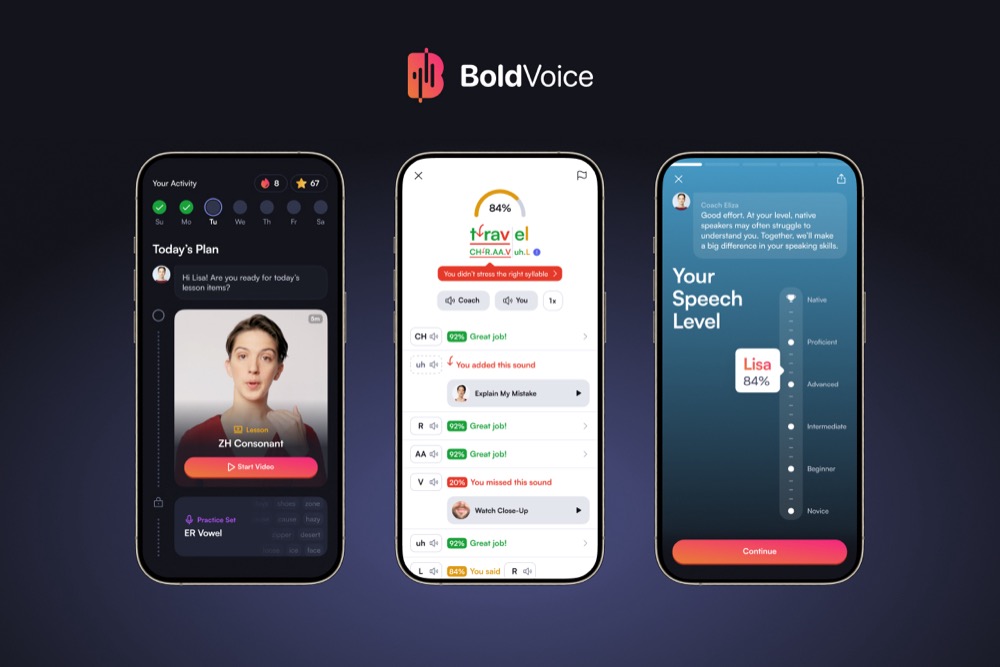
BoldVoice helps non-native English speakers to communicate clearly and confidently. Users record their voice and get instant feedback on their pronunciation and clarity from our proprietary speech recognition technology. They also receive video lessons from Hollywood accent coaches and personalized practice, adapted to their specific accent background and goals. For example, a BoldVoice user may sharpen the difference between the S and Z sounds, then practice a job interview with instant pronunciation feedback.
What inspired the start of BoldVoice?
 I came to the U.S. from Albania to attend Yale, and I experienced firsthand the challenges of being a non-native English speaker. I saw how my accent affected the way people perceived my intelligence and competence, in both professional and social settings. After meeting my cofounder Ilya Usorov, who had seen his immigrant parents struggle to advance their careers because of their communication barriers, we realized this was a universal problem affecting hundreds of millions of people globally. We founded BoldVoice to make high-quality speech coaching accessible to the millions who need it, not just actors or executives with private coaches.
How is BoldVoice different?
Unlike generic language learning apps, BoldVoice is specifically designed for pronunciation and accent coaching. Instead of teaching basic grammar and vocabulary, we help people who already know English “on paper” to speak it clearly and confidently in real life. Our curriculum was developed by Hollywood accent coaches who have trained A-list actors, and our proprietary AI can detect nuances in pronunciation that other speech recognition systems miss.
What market does BoldVoice target and how big is it?
We target non-native English speakers who want to improve their communication for professional and personal reasons. There are over 1.5 billion English learners worldwide, and research shows that having a foreign accent significantly impacts your career, from missed promotions to being underestimated in meetings. Our core users are ambitious global professionals—engineers, doctors, businesspeople—who have already learned English but want to be better understood, more confident, and taken more seriously. The global English language learning market is nearly $100B, and advanced communication coaching is a largely untapped segment.
What’s your business model?
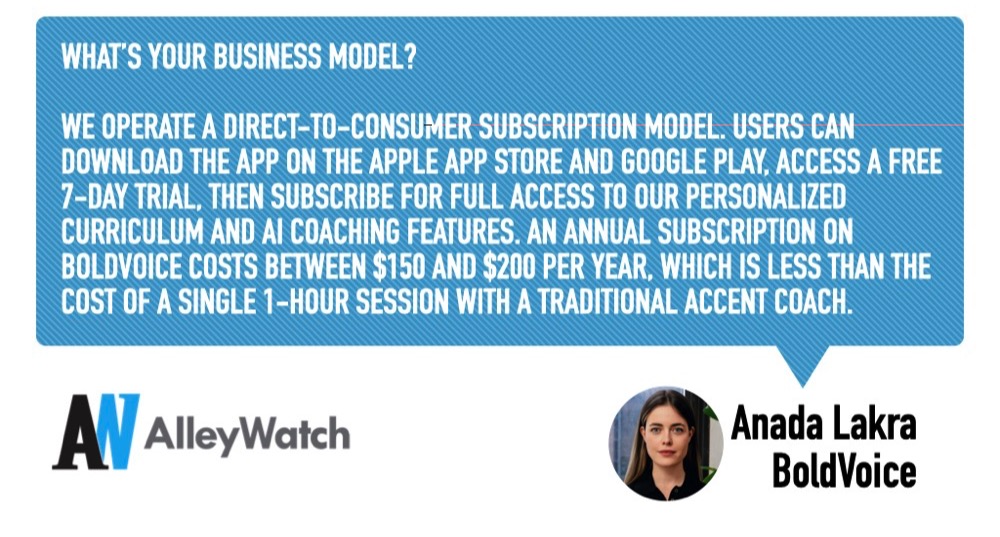
We operate a direct-to-consumer subscription model. Users can download the app on the Apple App Store and Google Play, access a free 7-day trial, then subscribe for full access to our personalized curriculum and AI coaching features. An annual subscription on BoldVoice costs between $150 and $200 per year, which is less than the cost of a single 1-hour session with a traditional accent coach.
How are you preparing for a potential economic slowdown?
We’ve built a $10M+ ARR business with just seven people, which means our burn is low and our runway is long. We’ve also proven that our product is valuable enough that people pay for it even in tighter economic times: career advancement and communication skills become even more important when job markets are competitive. Our focus is on delivering strong career ROI at a price point that can be accessed by millions of people.
What was the funding process like?
We came to the table with strong fundamentals: $10M ARR, 5M+ downloads, and clear capital efficiency. We didn’t need to raise, which is often the best time to raise. Many investors had followed our progress over time and had seen us consistently execute. We’d met with the team at Matrix before and thought highly of them, so partnering was an easy decision. The entire process from first meeting to close took just a few weeks.
What are the biggest challenges that you faced while raising capital?
The biggest challenge was helping investors understand that accent coaching and advanced communication training are a distinct category from general language learning. Many apps focus on the basics of learning a language, but for professionals, the last mile makes all the difference. Some investors just didn’t get that nuance. Fortunately, Matrix and our other investors saw how big and untapped this opportunity was, and our metrics and user stories spoke for themselves.
What factors about your business led your investors to write the check?
First, our capital efficiency: reaching $10M ARR with seven employees is unique. It showed that our AI-first approach actually works and that we can scale without burning cash. Second, the size and underserved nature of the market. Accent bias is a real problem affecting hundreds of millions of people, and no one else was solving it well. Lastly, our founding team’s personal connection to the problem: we’re building this because we lived it, and that authenticity resonated with investors.
What are the milestones you plan to achieve in the next six months?
We’re focused on three areas: expanding our AI capabilities beyond pronunciation, including intonation, clarity, and real-world speaking scenarios, growing our user base throughout the world, and thoughtfully building out our team by adding a handful more A+ players across growth, product and engineering. We want to maintain our culture of efficiency, while adding key roles that will help us scale.
What advice can you offer companies in New York that do not have a fresh injection of capital in the bank?
Focus obsessively on efficiency and unit economics. Hire a small team of people with incredibly high agency. Leverage AI to move faster. Your “drawbacks” are your advantage: a lean team with a clear mission that moves fast can outperform much larger, well-funded competitors.
Where do you see the company going now over the near term?
BoldVoice is becoming the go-to platform for people who already know English but want to sound confident and credible when they speak. In the near term, that means doubling down on our AI coaching content, expanding our suite of voice ML models, and reaching more users globally. Longer term, we see opportunities to expand to enterprise offerings and provide coaching for other languages.
What’s your favorite winter destination in and around the city?
In the city, a walk along the West Side Highway with a hot chocolate; if I’m getting out, the Catskills for a long weekend.